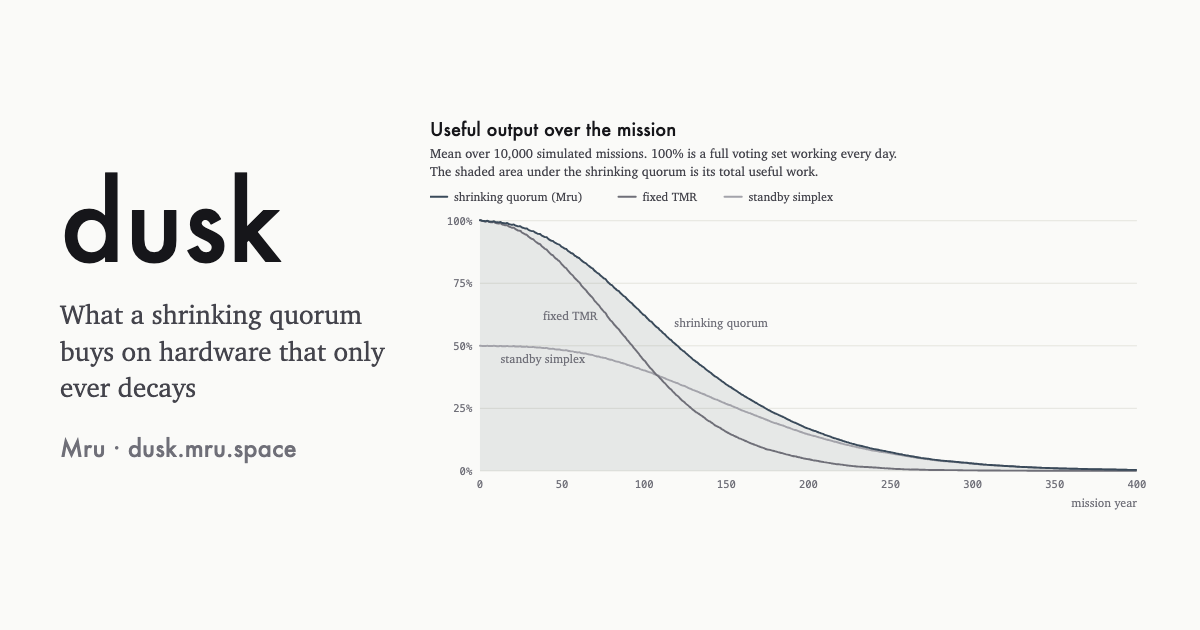
Heya, by design it loses hardware and keeps working with less. Graceful decline is the goal (so technically not anti-fragile!) What surprised us: + In orbit, nothing did. The laptop, the test bench and the satellite gave the same counts + Reaction time barely matters; if a ground team switches a failing system over in 1 day or in 6 months, total useful work comes out the same + Our approach isn't always best. If spare processors stay switched off and age slowly, keeping them offline does more work (we observed this in our simulator) + It has a cost. In 20% of simulated missions, it gives at least one wrong answer in its last years on a single processor. Standard triple voting gives none, but it stops much sooner For the long horizon we use Dusk, our open-source simulator: 10,000 missions over 1,000 years, no repairs. Processors wear out faster as they age, take random bit flips, and sometimes fail together We sweep every number we aren't sure of dusk.mru.space