Mru Aerospace
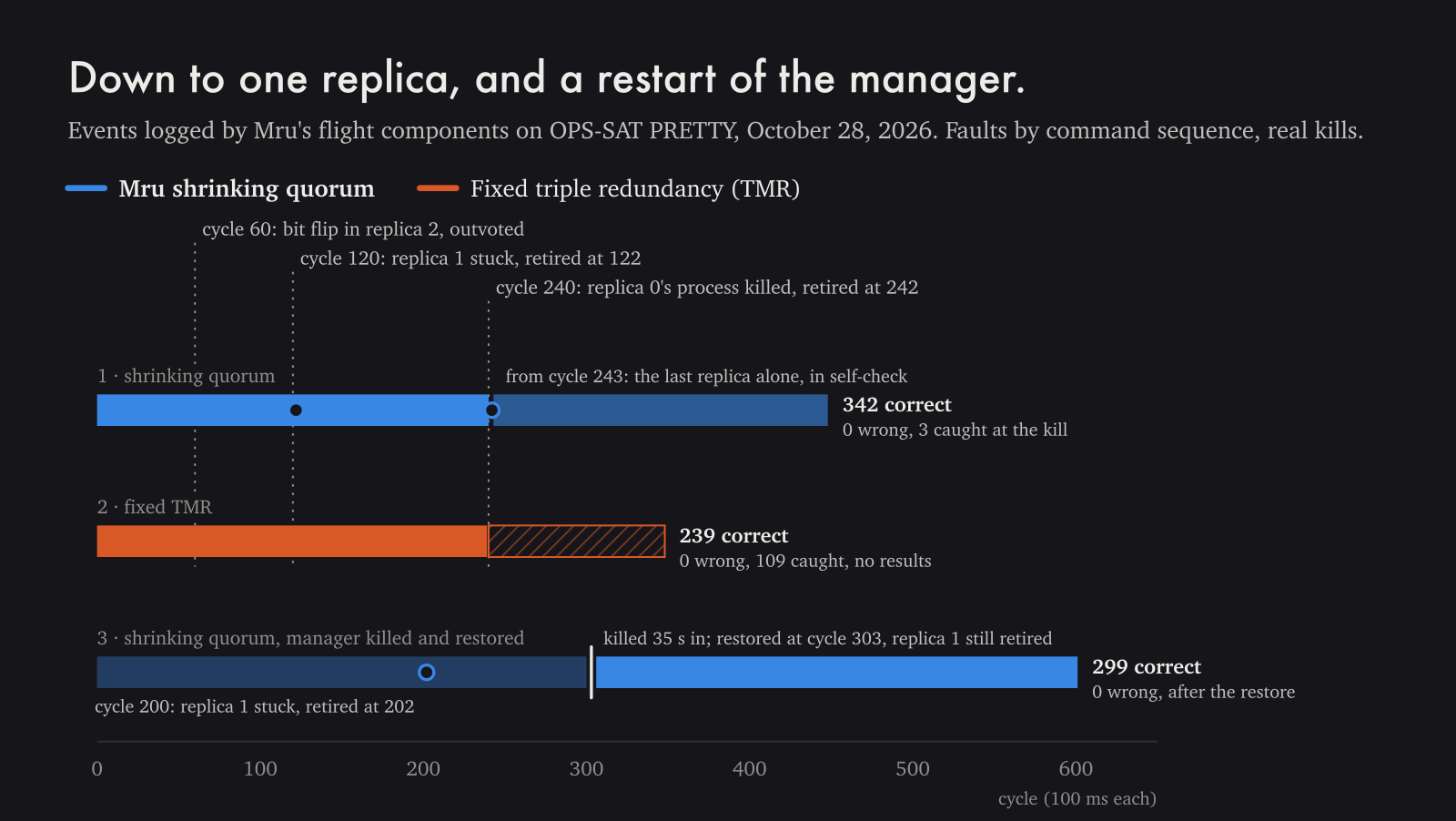
Falling back to one processor when the others die is easy. Doing it honestly is the hard part. In our simulator, a last processor that never checks itself gave at least one wrong result on 87% of missions. Ours checks its own work: 80% of the useful work, with 1% of the wrong results.
About 4,000 robot floats drift through the world's oceans. Every 10 days, each one sinks as deep as 2,000 m, rises back to the surface and sends home what it measured. Most are never recovered. The battery decides when the mission ends. The software decides how much good data comes home before then.
When an airliner's systems disagree with each other, there's a simple answer: land, and let a mechanic look. A satellite, a seafloor sensor, a probe between planets have nowhere to land. Their software has to keep working through the disagreement and say how sure it is.
The standard way to protect a machine from wrong answers is three processors voting. Once it can't outvote a bad one, it stops on purpose. In our simulator of 1,000-year missions with no repairs, stopping only comes out ahead if a single wrong answer costs more than 136 years of useful work. That's the number worth arguing about.
A pipeline can run for hundreds of kilometers through places where nobody lives, with monitoring stations along the way and patrols weeks apart. If a station's processor starts giving wrong answers, nobody may notice until the next patrol. Mru Field is built to catch it and say so.
No machine lasts forever. What matters is how it ends. Most stop at the first failure they can't sort out. Ours is built to lose parts one at a time and keep working, honestly, until nothing is left.
Most software is written for the next release. Ours is written for the day nobody can send one.